The Legend of Yurik Aslan
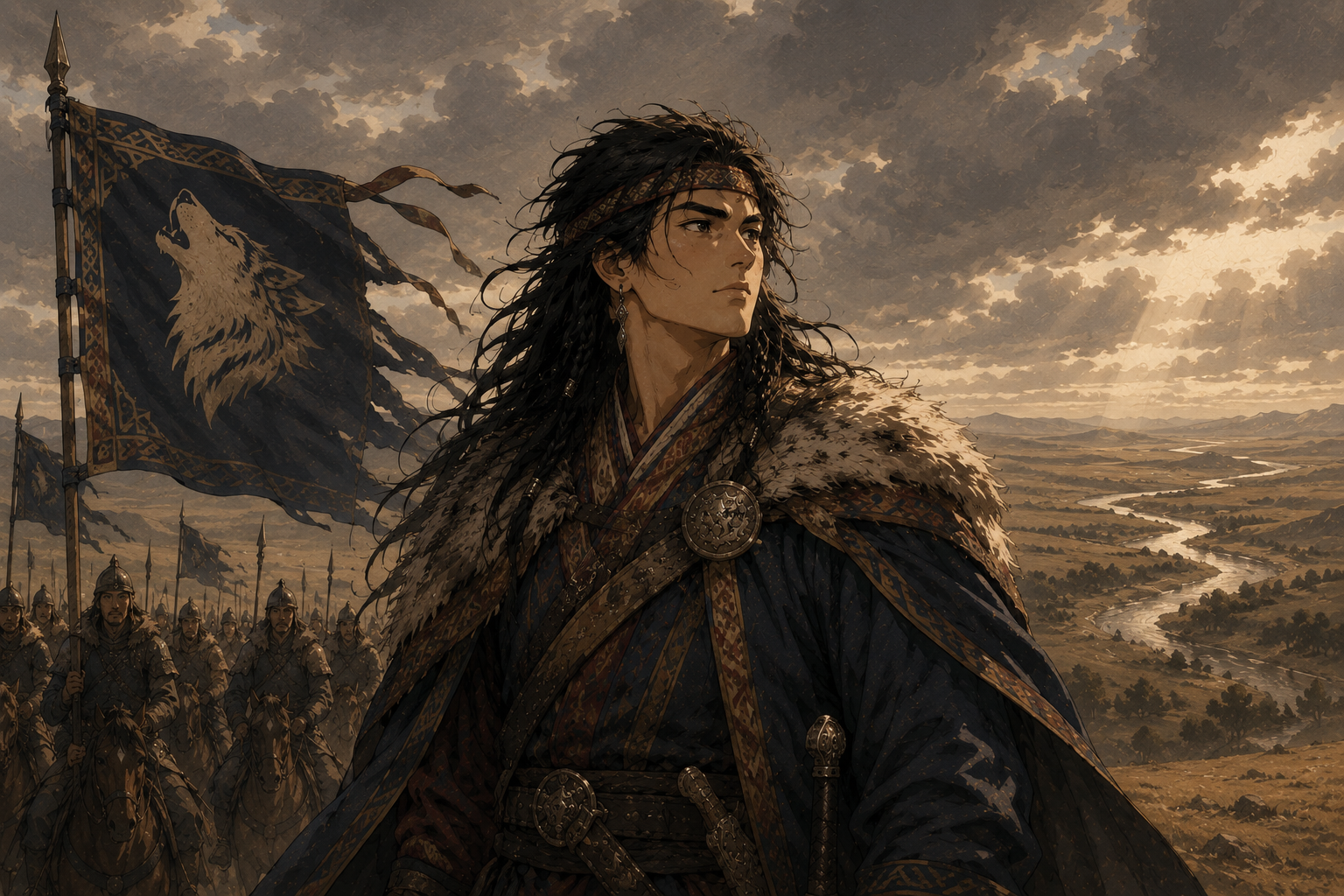
Yurik Aslan is the national hero of the Danetian people. His life is recounted in the Song of Danu, the Danetian national epic. The chronology of the poem places his adventures around the 750s CE, during the collapse of the Second Turkic Empire, one of the most turbulent periods in the history of the Eurasian steppe.
According to the Song of Danu, Yurik was orphaned as an infant after a bloody battle on the winter steppe. Left alone in the snow, he was discovered by a she-wolf, who suckled him and kept him alive until he was found by a widowed woman. She adopted the child and raised him as her own.
At the age of seventeen, his family’s cattle were stolen during a night raid. Determined to recover them, he set out in pursuit of the raiders. During the confrontation, he killed one of the thieves in self-defense. What was meant to be a brief expedition instead became the beginning of a lifetime of wandering.
He was captured by a tribal lord on charges of murder and of violating the tribe’s territorial authority. Rather than execute him, the tribal lord spared his life and took him into his service. In this way, Yurik traveled widely across the steppe and witnessed firsthand the gradual collapse of the Turkic order.
When the Second Turkic Empire finally imploded, Yurik fled westward along the great caravan routes of Central Asia. One of the most memorable episodes of the epic recounts his arrival at a prosperous city in Sogdia threatened by an approaching Turkic army. Yurik instructed the citizens to gather all their valuables into a single great pile and welcome the invaders as victors, allowing them to depart unopposed with the treasure. Burdened by their enormous plunder, the invaders became slow and disorganized. Yurik pursued them, defeated them in battle, and recovered the city’s wealth. But despite the victory, the citizens soon fell into bitter conflict over the redistribution of the treasure, and Yurik, blamed for the unrest, was driven into exile.
News of this victory reached the general Abu Muslim, who recruited Yurik during the Abbasid Revolution. After several military campaigns, Yurik once again departed, eventually crossing the Caucasus into Georgia.
It was in Georgia that Yurik first heard of a people living along the Don river: five kindred tribes collectively known as the Danetians. Though united by language and ancestry, the tribes had long been divided by a blood feud over rights to the river’s pastures. Every spring, as their herds returned to the floodplains, old grievances reignited into violence.
Yurik succeeded in reconciling the tribes by establishing a rotational system in which each tribe shared the most fertile pastures. The Song of Danu also credits him with establishing a code of honor among the tribes.
Following the unification of the five tribes, Yurik was acclaimed King of the Danetians. His descendants ruled the pastures along the Don river for generations, and it is here that the epic concludes. The later migration of the Danetians from the Don to Dobrudja, following the Battle of Levounion in 1091 CE, belongs to a later chapter of Danetian history.
The central concern of the Song of Danu is the question of how to live honorably in a world that rewards cruelty, deception, and violence. For this reason, it remains one of the most cherished works of Danetian literature and a defining expression of the nation’s identity.