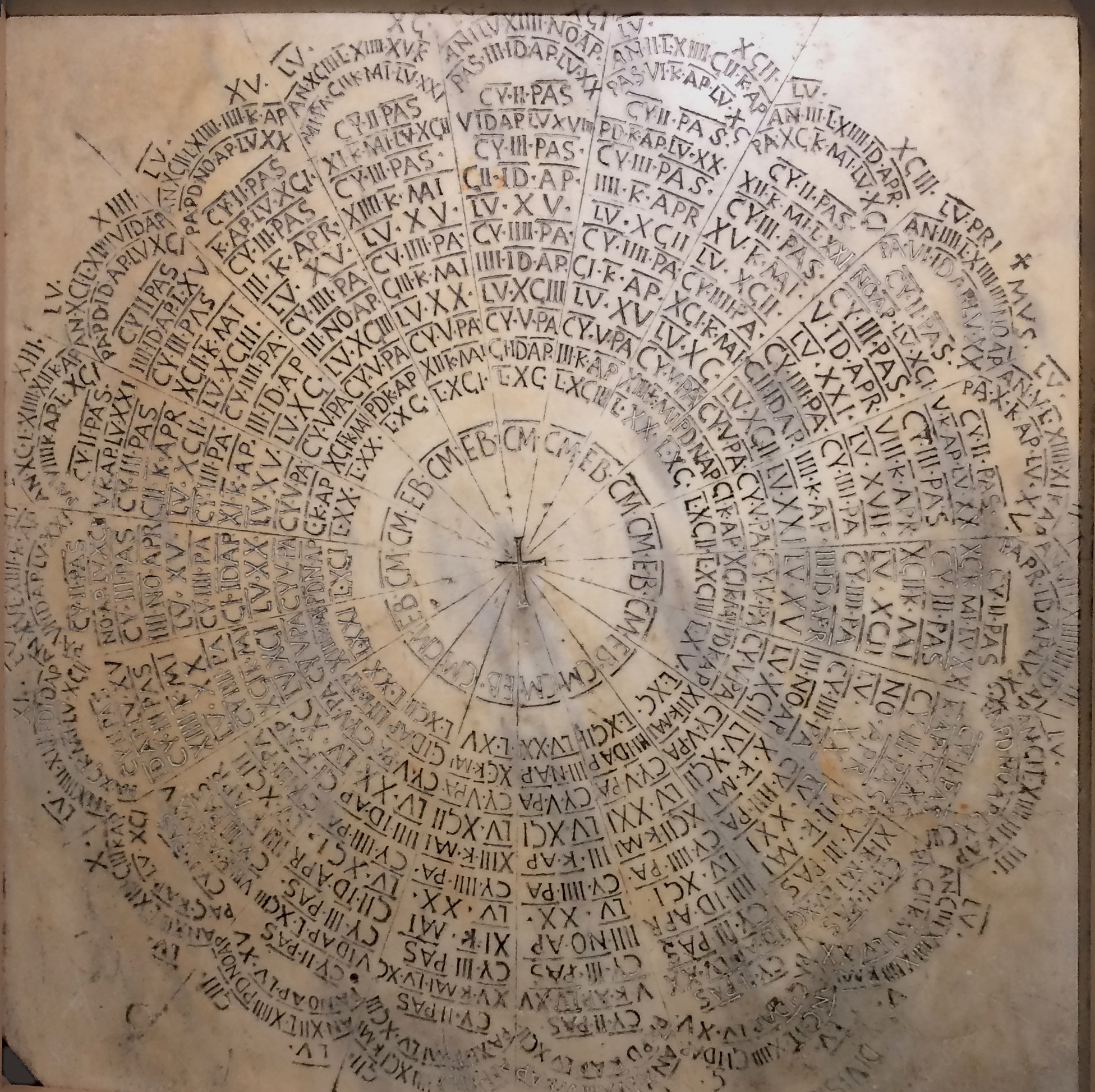
As we celebrate Easter this year, it’s worth reflecting how much effort has been invested over the centuries in solving the mathematical problem that is the computation of the date of Easter.
Traditionally, Easter is defined as the first Sunday that occurs strictly after the first full moon following the vernal equinox. In the Gregorian calendar, this leads to a surprisingly intricate set of rules, tables, and approximations.
But the Danetian calendar solves this problem by its very nature. The key lies in its construction. The Danetian calendar relies on a simple set of mathematical rules to ensure that each month starts on the new moon, and that the year starts on 01 Aries, which corresponds to the new moon closest to the vernal equinox. And because the full moon occurs at the midpoint of the month, this implies that the date 15 Aries corresponds to the full moon right after the equinox. Thus, the rule for Easter is simple:
Easter is the first Sunday after 15 Aries.
The date of Easter arises naturally from the rules of the Danetian calendar, giving it an advantage over the Gregorian calendar.
Prinam Pascham! Happy Easter!