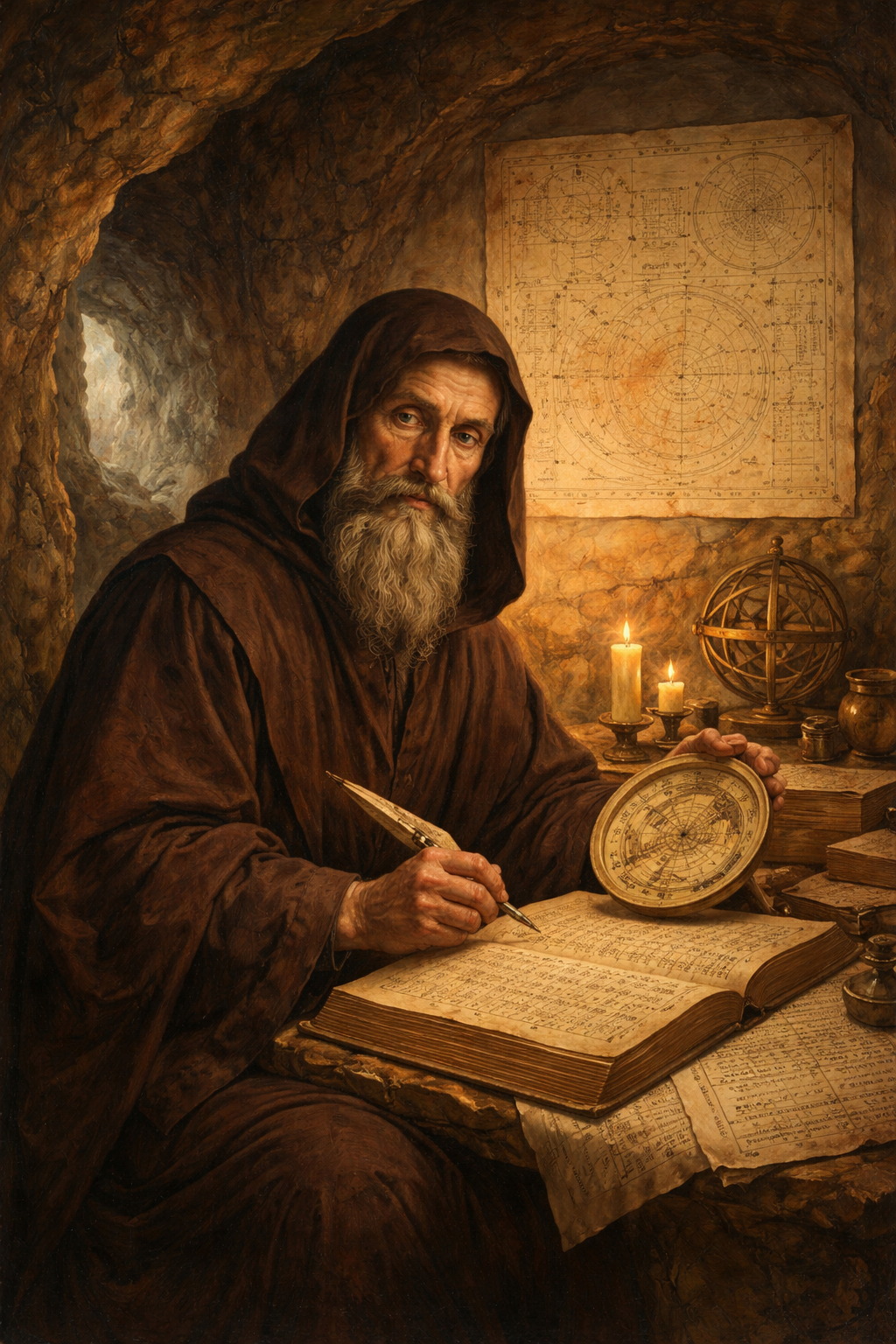
Myron Dorostolite was a 14th century Danetian polymath monk, best known for developing the algorithms used in the Danetian calendar.
He was born in a Danetian settlement near Silistra to a family of minor nobility in 1316. From an early age, he had a fascination with astronomy.
The Black Death arrived to the Black Sea region in 1347, which left Dobrudja devastated. Population loss left monasteries and villages half empty. As a result, Myron retreated to the Murfatlar monastery.
After encountering traders who brought copies of the Alfonsine tables, he began comparing the traditional Danetian reckoning of months and years with new astronomical data from Castile.
Notably, he discovered the significance of the fraction $\frac{25\,101}{850}$ for approximating the lunar month, and $\frac{4131}{334}$ for approximating the tropical year. In 1349, he published his algorithms for the Danetian calendar based on these ratios, along with precomputed tables for subsequent years. It is worth noting that the date of Easter is always predictable in his calendar.
In the 16th century, when Gregory XIII published his calendar reforms, the Danetian calendar is cited as an ingenious example.